
Accounts of ply split braiding from Dhova

Sadulram ji is a craftsperson practicing ply split braiding in Dhova village, slightly outside Khuri, which lies approximately 50 km outside Jaisalmer, Rajasthan. Their family was extremely warm and welcoming to us, eager to help and share their lifestyle. Sadulram ji works at his farm from 9 am till evening, only in the monsoon though which lasts approximately 3 months. Agricultural stability around the year is not possible due to the Thar region’s water table comprising of hard water. Sadulram ji grows three primary crops- guar, bajra, and moth. His farm is about 9 km away from his residence, covering which takes 2 hours on a camel cart.
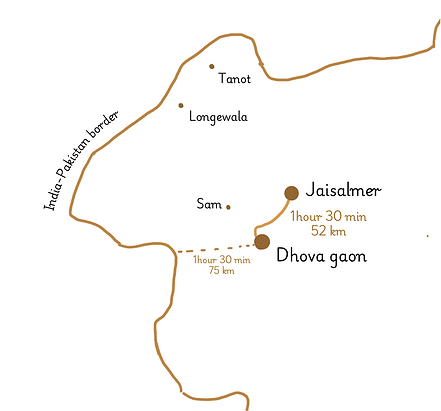
Illustrated map of the area
Sadulram ji has been practicing ply split braiding since over 40 years. He shared that his journey with the craft started by merely looking at these braided tangs, by which he figured out how to do it, teaching himself by trying to replicate various belts. Looking back over the years, there was a time where their entire community used to practice and cherish making tangs. Today, Sadulram ji remains the only craftsman in his entire village, and extended family who knows how to make tangs. However, they do weave charpais from time to time.
His grandchildren are now considering learning the craft. In conversation, they shared that they didnt realise people apart from their grandfather knew of, let alone like this craft. Since a few people have visited Sadulram ji out of curiosity for ply-split braiding lately, they feel proud of this lesser known skill honed by their grandfather. Gangaram ji, Sadulram ji’s son is currently encouraging his son to learn ply split braiding, poking fun at him saying “padhai me man nahi lagta toh dadaji se yeh toh sikh le” while Sadulram ji’s matenal granddaughter, Sonia, takes keen interest in acquiring this skill.

Me observing and learning as Sadluram ji braids a sample
Dhova gaon, Rajasthan, October 2025
Over the time I spent learning from Sadulram ji, he emphasised 3 things repeatedly. First being that this craft can be meditative, and will lead to beautiful creations if practiced slowly, without any haste. Second, nothing is permanent. He encouraged me to work and rework my stitches till im satisfied with the result. Third, having strong determination. He believes strongly in the saying “where there’s will, theres a way” / “jaha chah hai, waha raah hai.” Sharing his story of being a self taught craftsperson, he emphasised how any skill in the world can be attained with enough determination and practice, if you want it badly enough.

Me observing and learning as Sadluram ji braids a sample
Dhova gaon, Rajasthan, October 2025
Sadulram ji’s process starts with collecting shair from his sheep- both black and white. These are then washed, carded and spun into yarns. Two yarns of each colour are further spun to create a 4 ply thread (2 black, 2 white.) This choice of material, however, poses a limitation. There are very few white sheep in comparison to black ones. So, for instance, if he’s able to procure 500 grams of black yarn, he will only have 50-100 grams of white to accompany it. To combat this, he chooses to work with cotton thread (or “sooti ka dhaga”) when working on commercial or multiple pieces. For personal use, though, he prefers the old school way, with sheep yarn. To him, it feels more authentic and true. His only camel, Lal, doesnt were a tang every day since he pulls a camel cart. But on the occasions where they dress him up, they only use the traditional materials. Any tang Sadulram ji makes is only for Lal, sharing how the other village people use pre made fabric belts for their camels.

With Sadulram Ji and his family
Dhova gaon, Rajasthan, October 2025
He works with a variety of motifs inspired by day to day elements, including but not limited to oonth, chatri, ladki, aadmi, mor, bakri, hiran. The tool he uses to create these tangs of 2 types. Its either handcarved from wood, or fashioned with a toothbrush end using a hot wire. Its colloquially referred to as “hathiyar” or “goothni.” Sadulram ji braids his tangs in his down time at the farm, at home, or while socialising with neighbours, it being an effortless habit of muscle memory now. The key, he says, to neat and fine stitches is to make sure the threads are always tightly bound, to pull both ends after each stitch.
As khuri is shaping up to be a new, hot, tourist destination for its sand dunes now after Sam, locals are gearing up, ideating opening their camps and safaris.
“Oonth mere pas hai hi, gaana bajana tum dekhna, khana toh ho hi jayega, bas ban gaya apna camp safari”
-Sadulramji to his musician neighbour
As Khuri’s dunes shift under the weight of tourism and modernization, Sadulram ji’s laughter, his zest for life, and his hope become symbolic of a craft adapting to survive. Ply-split braiding stands as both memory and possibility: a testament that heritage, when lived and felt, never truly disappears. It simply waits for new hands, new meanings, and new worlds to gather around it once more.


Comments