
Kantha- Accounts from Bolpur

As my craft research documentation in college, i chose to study the beautiful craft of Kantha embroidery. This study was undertaken by visiting the Bhirbum district of West Bengal, India, specifically Bolpur, Nanoor, and Mahidapur, and spending time with the craftswomen to understand their craft and the stories behind it. Additionally, a second part of the study was conducted in Kolkata, which involved interviewing Kantha and Bengali culture revivalists, people working in government ministries concerned for handicrafts and textile crafts, and people in the Kantha industry/market. The goal of this project, beyond understanding the craft, is to capture its very essence, and carry it into contemporary designs, while preserving traditionally, and simultaneously
reimagining it into the modern scape.
Craft clusters of India are administered by the ministry of textiles in an effort to showcase the work of artisans across the country. As stated by the Ministry of Textiles, “A cluster is defined as a geographic concentration (a city/town/few adjacent village and their adjoining areas) of units producing near similar products and facing common opportunities and threats. An artisan cluster is defined as geographically concentrated (mostly in villages/townships) household units producing handicraft/ handloom products. In a typical cluster, such producers often belong to a traditional community, producing the long established products for generations. Indeed, many artisan clusters are centuries old artisan. Kantha embroidery is practiced in the Bolpur craft cluster of Bhirbum district, West Bengal. It is home to over 400 artisans and 25 self help groups.
Bolpur is a city in West Bengal, India and the headquarters of the Bolpur subdivision. It is the largest city in the Birbhum district and the 28th most populated city in West Bengal. Bolpur is located on the banks of the Ajay and Kopai rivers, 150 km north of Kolkata. It is known as a cultural and educational hub of West Bengal, and is famous for Visva Bharati, the university established by the Nobel laureate poet Rabindranath Tagore.
Mahidapur is a village located near Bolpur in the Birbhum district in West Bengal, India. It is situnted 11.8km away from sub district headquarters Sriniketan and 35.5km away from district headquarter Suri. The total geographical area of the village is 493.83 hectares. Mahidapur has a total population of 4,080. There are about 894 houses in Mahidapur village. A large section of the population is either Muslim, or belongs to the Scheduled Castes and Tribes. The village is sparsely populated and houses are mostly kaccha with a few consecutive pucca houses.
Nanoor is a town in Bolpur subdivision. It has a police station in Nanoor CD Block in Bolpur subdivision of Birbhum district in West Bengal. Nanoor block covering 24 villages, is economically backward. It has many artisan families who live below the poverty line. A large section of the population is either Muslim or belong to the Scheduled Castes and Tribes.

Map of the Bolpur craft cluster in Bhirbhum
Rabia Khatun and G. Mostafa run a small Kantha works setup in Bolpur. Mr. Mostafa is a former army official, who oversees the design process of the Kanthas. He creates motifs and compositions for the sarees and dupattas, and trace tranfers them onto the fabric blanks.
Mrs. Khatun then embroiders samples that communicate the idea of the piece, and they give the materials and swatches to one of the artisans they have employed. The craftswoman takes these home, and completes the Kanthas in her own time, which, on an average, is six to eight months for a standard piece. The more intricate pieces take
upwards of a year at times. They usually work on commission pieces, and make collections to be shipped off to a variety of places pan India, and internationally, including but not limited to London, Paris, Istanbul, Milan, Dubai, New York, and Oman.

Rabia Khatun and G. Mostafa
Bolpur, West Bengal, March 2024
Tuli is a Kantha craftswoman who has recently started working in the field. Based in Mahidapur, she is one of the youngest Kantha artists in the circuit. She makes kanthas on kurta blanks, that can be easily replicated for commercial purposes. With her process, she makes 2-3 products per day. Her design revolves around simple, small, quick motifs scattered on the body of the kurta. She makes them in a variety of sizes from 32, all the way to 50. With this technique, she creates beautiful pieces suitable for everyday wear. Her father is a cattle farmer, who frequently travels to Bolpur, and occasionally Kolkata, where he takes Tuli’s creations with him to sell to bigger retailers for a very low price; Rs. 100-150 per kurta on an average. They rely on a wholesale model to earn from Tuli’s skill in the craft.

Tuli working on a kurti
Mahidapur, West Bengal, March 2024
Padma Shri Takdira Begum is one of the most widely accredited Kantha artists in the country. She has recieved a plethora of accolades from the district, state as well as national level. She specialises in Nakshi kantha, which is the most intricate form of Kantha. She makes elaborate sarees, bedspreads, odhnis, headscarves and swaddles in the authentic, traditionally Bangladeshi technique by sewing multiple layers of fabric together, and without using an embroidery hoop. Her Kanthas have a very refined finish with the iconic ripple effect. At the age of over sixty years, she has experience in the embroidery of over forty five years. Based in the heart of Bolpur, she pracices her craft in a humble space
while tending to her family and grandchildren.

Me with Padma Shri Takdira Begum
Bolpur, West Bengal, March 2024
Tajkira Begum is a highly accomplished Kantha craftswoman in India. Living in Nanoor, she specialises in authentic Nakshi Kantha as well. With a plethora of honours from the state and national government, she has had a tremendous role in the empowerment of women in Nanoor. For over thirty years, she has been providing raw materials and teaching her craft to the women in her village. Moreover, she provides them with a means of selling their works to her contacts, either independently or with her as the middlewoman. With support from the state government, she provides kanthas that are sold in state emporiums and Biswa Bangla stores all over Bengal. Moreover, her work has found its way all over India, found in outlets in Delhi, Mumbai, Bangalore, Guwahati, Jaipur, Chennai, etc. She is an incredibly humble woman who set out with a simple aim after her marriage; to help the women of her village gain financial independence.

Me with Tajkira Begum
Nanoor, West Bengal, March 2024
Key findings:
One of the key observations made was the similarity in workstyle of all artisans. Kantha is merely part of their life that melts into its other aspects, unlike how other crafts function. Even with other Embroidery crafts such as chikankari, the craft takes up a significant part of the artisan’s life; the craft has its own physical space and scheduled time dedicated to it. Kantha, however does not behave in that manner. It seems to be an activity that the woman finds time for when she isn’t occupied with other work, when she has time to unwind. This oroves furthermore that kantha is a domestic craft in its essence.
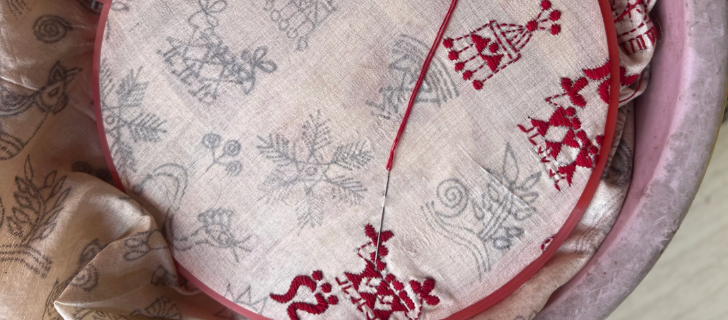
Interestingly, as pointed out by Mr. Mostafa in Bolpur, Kantha has striking parallels with the aari embroidery done in Howrah today, in terms of designs and embroidery styles. The key difference is the technique, which makes it the “commercialised kantha” according to him. Essentially, as a kantha saree is made by a single craftswoman using a medium 12 inch embroidery hoop, aari embroidery comprises of the saree being fixed in a full length frame, being worked on by 5-6 craftswomen at a time. This allows them to cut the production time into a fraction; from 6-8 months in kantha, down to merely 3-4 weeks. Moreover, Kantha is truly a craft of generational wealth, with these women having experience of nearly 50 years under their belt.
However, they frequently commented on the lack of interest shown by the younger generations to learn and propagate this craft. This puts Kantha in severe danger, since it is purely a feat of slow fashion, and with decreasing sources of supply, it is only a matter of time that it is forgotten again and moved past. Furthermore, another one of the primary challenges confronting Kantha embroidery is the gradual erosion of the intergenerational knowledge and skills necessary to sustain the craft. As younger artisans are drawn to more lucrative and ‘modern’ employment opportunities, the critical link between seasoned practitioners and budding apprentices has been disrupted. The time-honored system of passing down techniques, motifs, and cultural narratives from one generation to the next is under severe strain.
In the end, it is still amazing to see the amount of pleasure and satisfaction the craft is bringing its artisans. For most of them, it brings with itself a deep sense of pure joy. As Tajkira Begum eloquently put it, every stitch makes her feel like she is carrying a legacy that is centuries old; she ponders over all the pain and joy kantha has been through with its makers, while looking back at her own journey simultaneously.
Despite its rich cultural legacy and enduring artistry, the traditional craft of Kantha embroidery in India is facing a growing threat of extinction in the face of modernization and shifting societal priorities. As the lure of mass-produced textiles and the demands of the global marketplace intensify, the once-thriving Kantha tradition finds itself on the precipice of being lost to future generations.
One of the primary challenges confronting Kantha embroidery is the gradual erosion of the intergenerational knowledge and skills necessary to sustain the craft. As younger artisans are drawn to more lucrative and ‘modern’ employment opportunities, the critical link between seasoned practitioners and budding apprentices has been disrupted. The time-honored system of passing down techniques, motifs, and cultural narratives from one generation to the next is under severe strain.


Comments