
Kantha- an overview

Kantha’s etymological roots lie in the sanskrit word, “Kontha,” which translates to rags. Being one of the oldest crafts of india, Kantha originated in rural Bengal as a means of upcycling worn out cotton sarees and dhotis that could not be worn anymore, to create quilts, wraps, and swaddles to keep warm in the cold weather. As it became more ornate, it evolved into a means for women to create a symbol of their love and warmth for their partner, or children to keep with them when they’re away from home. Kantha is and artform that never died, but went through multiple transitions in terms of its value and uses.
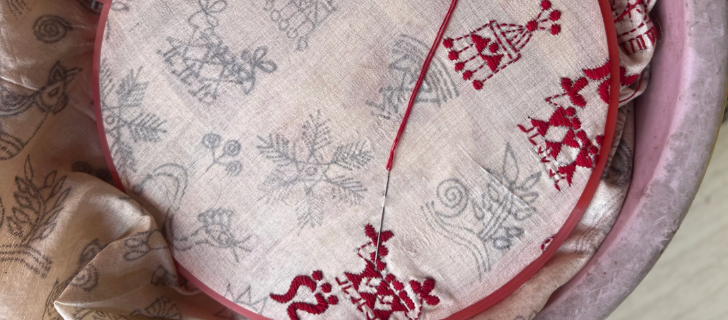
Work in progress piece by Tuli
Mahidapur, West Bengal, March 2024
The beauty of Kantha, for me, lies in its very simplicity. It is fascinating to see how something as simple as a running stitch can become such a significant vessel of elegance, while simultaneously being a means of visual storytelling. The craft tells the story of not just the woman making it, but all that came before her too.
The interesting thing about Kantha is its very origin. It is a craft that was born out of desperation, in the backdrop of hard external conditions. It started simply as a means to reuse older sarees and dhotis to create something that keeps one
and their loved ones warm. It is predominantly a women’s craft since its very inception. The earliest noted mention of kantha has been recorded in Jasim Uddin’s poem, “Nakshi Kanthar Math” The craft has gone through a
tremendous evolution ever since.
What originated as a basic quilting technique quickly evolved into a symbol of endearment. It turned into a way for women to send a little element of home and their warmth with their spouses or children living far from home. Eventually, an aesthetic element got attached to its sentimental value as women started recreating things they saw in their surroundings. And ever so slowly, kantha went from the private space to something proudly exhibited in public quarters. Kantha comes in multiple levels of complexity. This depends vastly on the purpose of kantha, skill set of artisan, commercial goals, and many more.

Kantha bedspread by Padma Shri Takdira Begum
Bolpur, West Bengal, march 2024
These factors also determine the motifs and patterns seen in the embroidery. For instance, a kantha made for a new bride will traditionally have elements symbolic of fertility, and prosperity. One made for a baby will have elements representing growth, family, education, etc. This gives an interesting insight into how the collective subconcious of the culture has labelled different visual element and placed them in corelation with abstract ideas as a means of prayer and manifestation.
What I find so special about kantha is that it has always been a means for women to uplift and support themselves in the face of adversity. Be it extreme poverty, the colonial age, famine, independence war, the Bangladeshi liberation war of 1971, or even something as recent as the coronavirus pandamic. In recent times, Kantha has been a means for women of rural Bengal to support themselves and take a step towards financial independence. The government of West Bengal and Self Help Groups play a major role in enabling women from remote parts of the state to connect, and gain employment opportunities.


Comments